
Building Science
Common Questions and Concerns
Fire Resistance:
In the last 20+ years, extensive research has been done by both public and private institutions to determine the efficacy of straw as a building material. Driven by the need to meet building code standards, researchers have performed seismic, fire, R-value, moisture, and structural testing on straw bale buildings.
Fire tests have found that straw walls can withstand 1000 degree temperature for a 90 minute period, with no combustion, minimal smoking, and heat transfer.
While loose straw is very flammable, straw under compression and surrounded by either plaster or a suitable air barrier does not have enough oxygen to burn. In tests, when high temperatures were applied to one side of the wall, the temperature on the other side of the wall was very slow to change. This website has compiled a list of a few of these tests done in controlled conditions https://www.strawbale.com/blog/fire-testing-strawbale-walls.
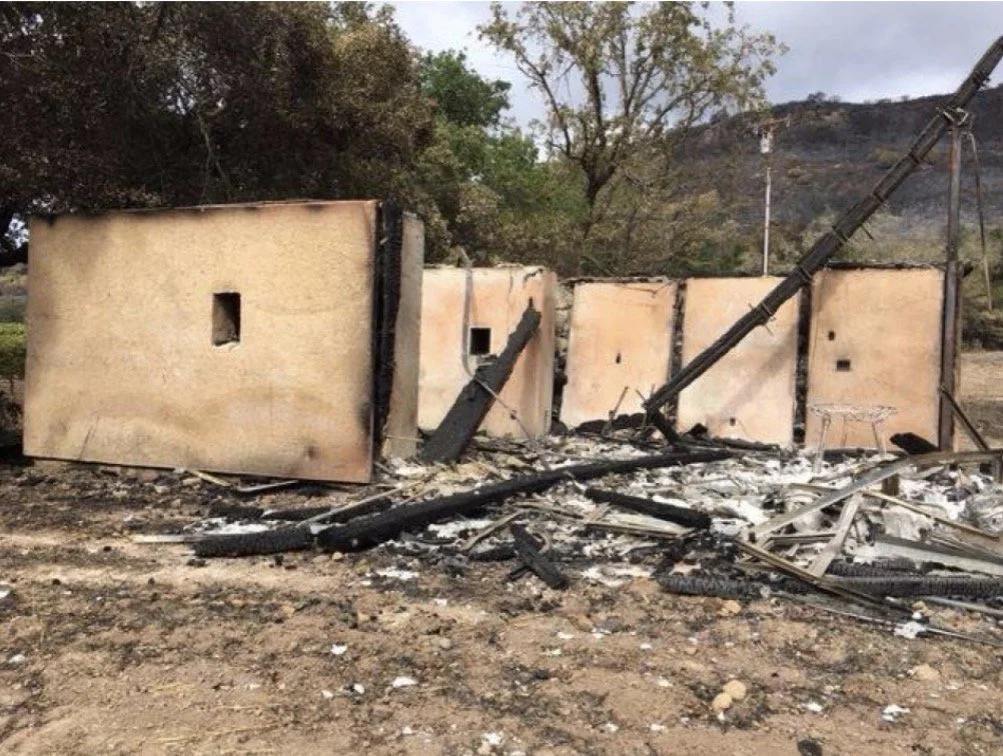
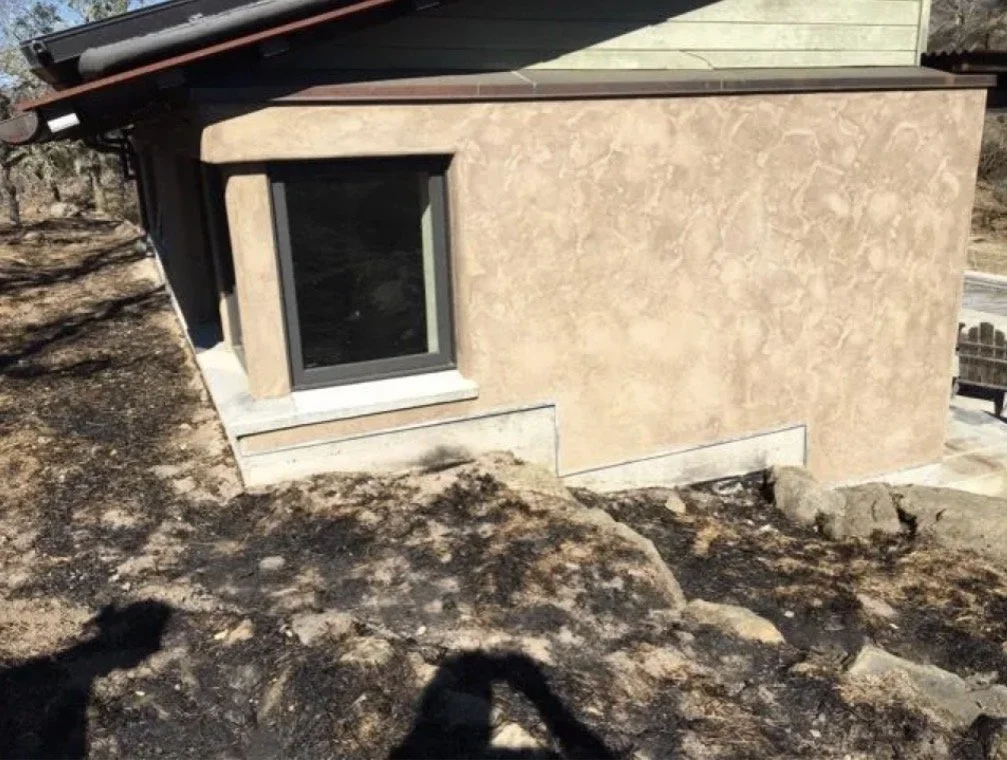
Perhaps more impressive is the performance of straw bale homes in wildfires. In California, straw bale homes have survived where neighboring homes have burnt down.
When straw bale homes caught fire, it was the roof assembly that burned, while the straw walls remained almost untouched. To the right and directly below are photographic examples of straw bale walls surviving the wildfires.
R-Value and Thermal Envelopes:
R value is the measure of a material’s resistance to heat flow. Some materials are much better conductors of heat, like metal, while others slow the transfer of heat, like wool or straw. The higher the R-Value, the slower the transfer of heat.
R-value is measured per inch, using wood (R-1) as a standard. So, a material with a value of R-3, at 6 inches thick, would equate to about R-18. Our straw bale panels, which have an R-value of somewhere between R-2 and R-3 depending on different test results, have an overall R-value of R 30+.
The current code standard is R-19; most traditional stick-built homes do not attain this level of insulation. In order to understand why this is, you need to understand the thermal envelope of a home. This is considering the average R-value of all the exterior-facing elements of a house. A traditional house, for example, may use R-19 insulation in between each stud and framing member, but that R-value is broken every time it meets the wood framing, which acts as a cold bridge at only about R-6. So, when a home insulated with R-19 fiberglass accounts for all the framing for top plates, studs, window and door framing, the average R value will drop well below the code required standard, likely in the R-12 -R-15 range.
One of the benefits of straw bale SIPs is that there is almost no thermal bridging at all in the wall system(less than 2% of the surface area) This means that there is a continuous blanket of insulation around the whole wall system, except of course in the glazing at windows and doors, as well as intentional wall penetrations for ducting and utilities. When paired with a good roof and foundation insulation, a straw SIP building meets much higher energy efficiency than traditional housing, and can be augmented to hit the highest standards of efficiency, such as passive house standards, with a bit of additional exterior insulation.
Thermal Performance of Straw Bale Homes:
For those new to building science and very energy-efficient home design, a few concepts must first be covered to understand why properly assembled strawbale SIPS vastly outperform traditional stick-built homes.
Some key things to understand are: air exchange, R-value, and Thermal Envelopes.
Air Exchange:
Modern homes are built to have as little uncontrolled air exchange as possible. This is because a leak in a home's air barrier can contribute significantly to heat loss and to unwanted moisture entering the home. A house that is at a different temperature than the outside environment is under pressure, since those different temperature environments will seek to balance out if given the opportunity. If you have ever experienced cold air rushing under a door, or stood at the mouth of a cave and felt the cold air pouring out, then you have experienced this event. The thing to understand is that a small hole in a building assembly can lead to a large amount of heat loss. A good visual example of this is a pinprick in a garden house. Even though the hole is small, a lot of water is spraying out.
Another thing to understand about air loss is that warm air can hold a lot more moisture than cold air. What this means for your home is that as moist/warm air escapes the building envelope and meets outside air, condensation and moisture are let into the building assembly. This can cause rot and mold in a home if not addressed. Old houses are so leaky that they dry out quickly, and this is not so much of a problem. Newer, tighter homes must take this problem seriously for long-lasting, healthy homes. In order to have fresh air into a tight home, air exchange is controlled through the use of mechanical ventilation, and of course, windows and doors.
When we build and assemble the straw panels, we take care to “air detail” them so that their unwanted air exchange is minimized. Seams are silicone and taped, and interior air barriers in the form of plaster or a roll-on, moisture-permeable air barrier are applied. The outside sheathing is also constituted of materials which allow sufficient vapor permeability for drying to the outside, whilst being carefully air detailed as well. A rainscreen is added between sheathing and siding to allow for drying out of any moisture that does get behind the siding.
Moisture, Pests, and the Big Bad Wolf
One of the biggest threats to any home, including straw bale homes in our region (Appalachian Mountains) is moisture. Moisture in a home can cause mold, rot, and eventually building failure. It is the most important factor to consider in house design, and we take that very seriously. Properly managing moisture requires a combination of good design and proper detailing. The design includes good roof overhangs, grading away from the home, proper flashing and sealing, considering local elements like prevailing winds, sunlight, and groundwater.
The detailing consists of making sure our SIPs are tight, caulked at all seams and breaks between panels. We take care to add a rain screen on the outside of the house, which allows airflow behind the siding to dry out any moisture. Underneath the sheathing, a vapor-permeable air barrier goes against the straw and is siliconed to the framing. This further stops liquid water from moving in, and air from moving through the panels, but allows any other forms of moisture in the bales to dry to the outside. This allows drying to the outside from vapor diffusion, which is the movement of vapor through solid materials even if there are no holes. On the inside of the panels, we also seal the seams and add an interior vapor-permeable air barrier, such as plaster or an appropriately permeable air barrier under the drywall.
Panels are kept off the ground and are attached to the mud sill and floor framing, so that any major leaks inside will not get to the straw. There is much more data available on straw bale homes and moisture management, and they are a highly effective building material when done properly.
Contrary to the popular wisdom of nursery rhymes, a straw house will not blow down! When built properly, it will not burn, will not rot, or be rodent-infested. Our straw houses will outperform traditional stick-built houses on energy efficiency, and our attention to detail and design will provide people with housing that is more than worth the investment.